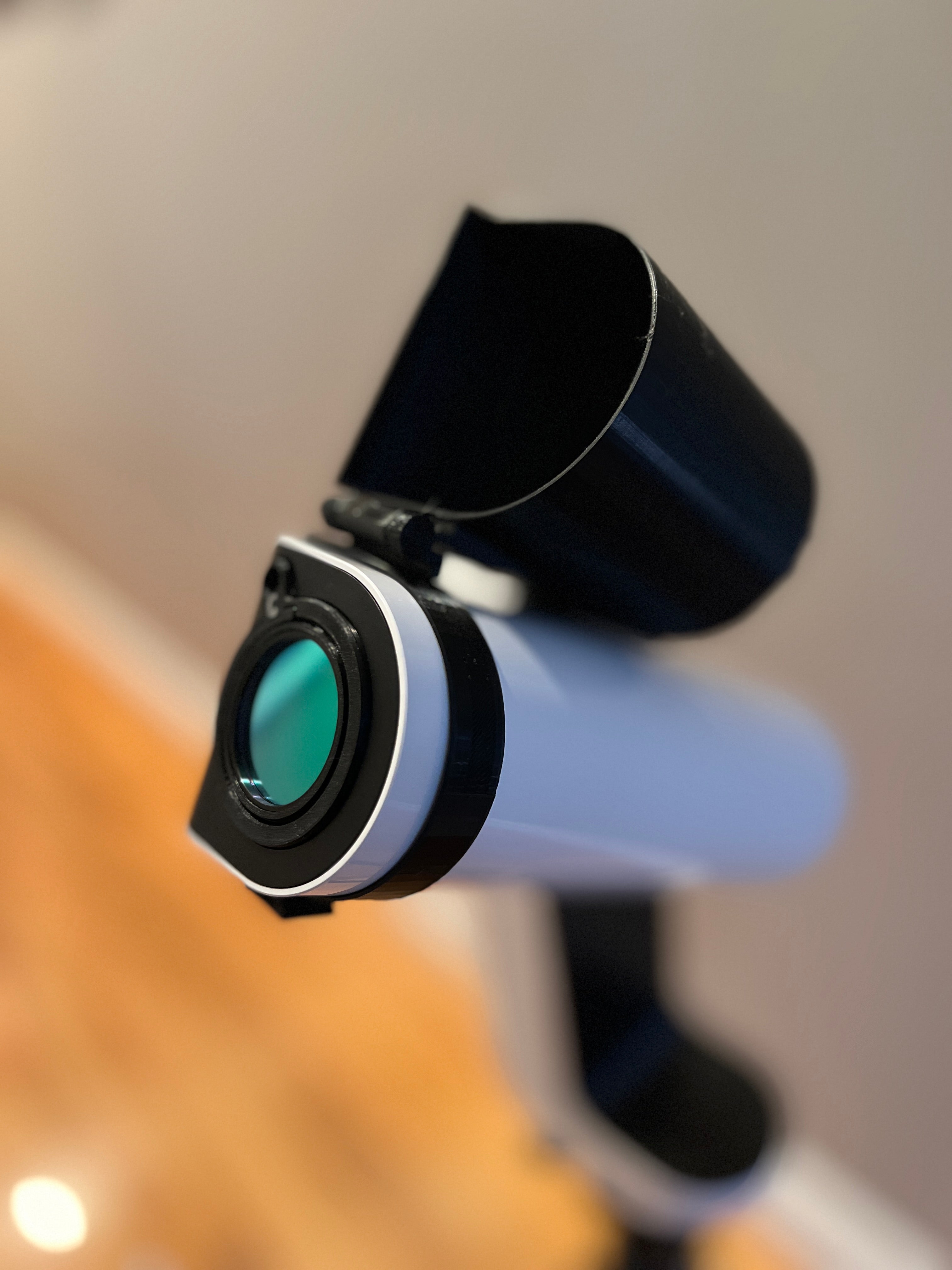
A filter is one of the biggest upgrades you can make to a Vaonis Vespera, but the right one depends on what you photograph and how dark your sky is. This guide compares the three main options, Dual Band (DB), CLS and Solar, for the Vespera, Vespera II, Vespera Pro and Vespera Passenger.
Quick answer
- Emission nebulae from a city or suburb (Orion, Rosette, Veil, Heart, North America): Dual Band
- Mixed targets under moderate light pollution, keeping more natural colour: CLS
- Galaxies and star clusters under dark skies: no filter
- The Sun, sunspots and solar eclipses: Solar filter (essential, never optional)
Dual Band (DB) filter
A dual band filter passes only two narrow bands of light: H-alpha (red) and OIII (teal). These are the wavelengths emission nebulae glow in, and it blocks almost everything else, including most streetlight glow. The result is much more contrast on nebulae, even from a light-polluted backyard.
Best for: emission nebulae and supernova remnants.
Not ideal for: galaxies, reflection nebulae (like the Pleiades) and star clusters, because it blocks much of their light.
When a DB filter is fitted with a chip-equipped adapter, the Vespera detects it and the Singularity app switches to Dual Band mode.
CLS filter
A CLS (City Light Suppression) filter is a broadband light pollution filter. It removes the most common artificial light wavelengths and lets most other light through. Contrast is lower than with a dual band filter, but colour looks more natural and it works on a wider range of targets.
Best for: general imaging under suburban skies and broadband targets where you still want some light pollution reduction.
Not ideal for: very dark sites (you lose some signal for little gain) or LED-heavy cities (LED light is broadband and harder to filter).
Solar filter
Never point a Vespera at the Sun without a certified solar filter. It can damage the sensor and optics. An ISO 12312-2 certified solar filter cuts sunlight to a safe level, so you can image sunspots, solar transits and eclipses.
Comparison table
| Dual Band | CLS | Solar | |
|---|---|---|---|
| Main use | Emission nebulae | General light pollution reduction | The Sun & eclipses |
| Light pollution | Excellent | Moderate | N/A |
| Natural colour | No (false-colour look) | Mostly | N/A |
| Galaxies | Poor | Fair | N/A |
Using 2" filters on Vespera II, Pro and Passenger
Vespera doesn't take standard astronomy filters directly. A 2" filter adapter replaces the lens ring and holds any standard 2" (M48 × 0.75) filter, so you can use popular filters such as the Optolong L-eXtreme (dual band), L-eNhance or L-Pro.
- Vespera Dual Band (DB) Filter Adapter
- Vespera CLS Filter Adapter
- Vespera Solar Filter
- DB + CLS + Solar Bundle – all three at a lower price
FAQ
Can I stack a DB and a CLS filter?
There's no benefit. A dual band filter already blocks what a CLS filter blocks.
Which filter should I buy first?
If you live in or near a town and love nebulae, get the Dual Band. If you want one filter for many targets, get the CLS.
Do these work on every Vespera model?
Yes: Vespera (original), Vespera II, Vespera Pro and Vespera Passenger.
Browse all Vespera filter adapters.