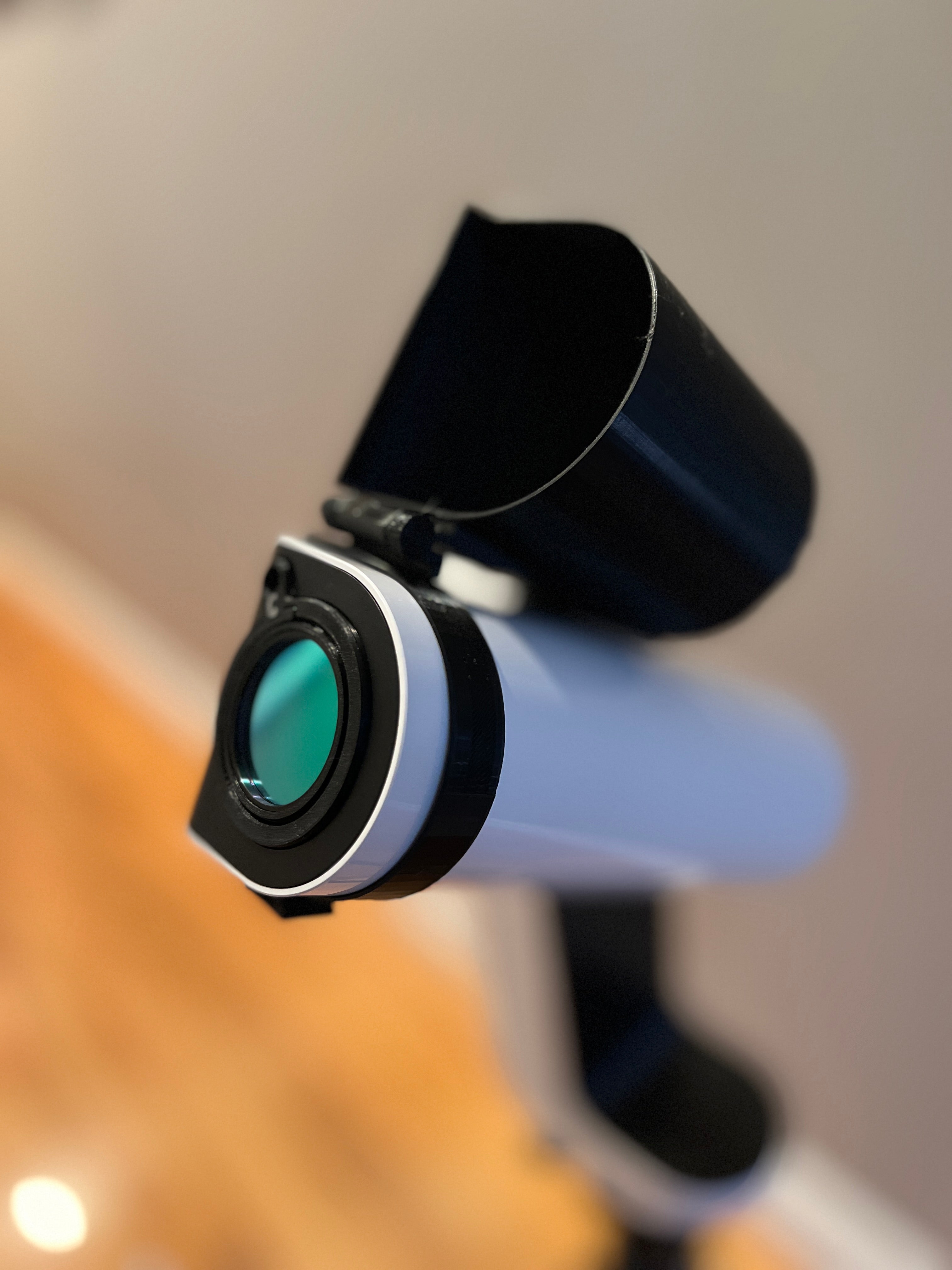
The Vaonis Vespera makes an excellent solar eclipse camera: it tracks the Sun automatically, frames it well and saves every image. But it must have a proper solar filter. This guide covers safety, setup and tips for photographing the Sun and solar eclipses with the Vespera, Vespera II (Vespera 2), Vespera Pro, Vespera Pro 2 and Vespera Passenger.
Safety first
Never point any Vespera at the Sun without a certified solar filter. Focused sunlight can damage the sensor and optics within seconds. Use a solar filter certified to ISO 12312-2 that covers the whole lens opening. Check it for scratches or pinholes before every use.
What you need
- A Vaonis Vespera (any model)
- A certified Vespera solar filter
- A charged Vespera battery, plus a power bank for long events
- A stable, level spot with a clear view of the Sun's path
- Eclipse glasses for your own eyes
Setup step by step
- Before you go: practise on the normal Sun a few days early. Sunspots make a great test target.
- Fit the solar filter on the Vespera before powering on and before the arm points anywhere near the Sun.
- Level the Vespera on a firm surface and power it on.
- In the Singularity app, choose the Sun as your target and follow the app's instructions.
- Check focus and exposure on sunspots or the Sun's edge before the eclipse starts.
- Let the Vespera track the Sun through the partial phases and capture images at regular intervals.
During totality
For a total eclipse, the Sun's corona is only visible during the few minutes of totality. Experienced eclipse photographers sometimes remove the filter for that window only. If you do, refit the filter before totality ends, because the first flash of sunlight returns suddenly. If you're not confident, keep the filter on the whole time. The partial phases alone make a great sequence.
For an annular or partial eclipse, keep the filter on the entire time.
Upcoming eclipses
- 6 Feb 2027: annular solar eclipse (South America, Atlantic, parts of Africa)
- 2 Aug 2027: total solar eclipse (Spain, North Africa, Middle East), one of the longest totalities of the century
- 22 Jul 2028: total solar eclipse (Australia and New Zealand)
Check a local eclipse map for exact times and coverage where you live.
Tips for great eclipse images
- Arrive early. Clouds and setup problems always take longer than expected.
- Keep the Vespera out of direct midday heat between sessions.
- Bring a power bank. Eclipses last 2–3 hours from first to last contact.
- Combine the partial phases into a time-lapse or a sequence image afterwards.
- Use a dew shield to cut glare from the bright sky around you.
FAQ
Can I use the Vespera to look at the Sun on normal days?
Yes. With a solar filter fitted, you can image sunspots any clear day.
Does the solar filter fit Vespera 2 and Pro 2?
Yes. It fits Vespera, Vespera II (Vespera 2), Vespera Pro, Vespera Pro 2 and Vespera Passenger.
Is the solar filter certified?
Yes. See the product page for certification details.
Planning a full kit? The DB + CLS + Solar bundle covers nebulae, light pollution and the Sun.